What is Artificial Intelligence (AI)?
Artificial Intelligence is the umbrella term for systems that perform tasks normally requiring human intelligence. Think of processing language, recognising patterns and making predictions.
Machine Learning and Data Science are part of that story, but they are not the same thing. Machine Learning is a part of AI where models learn from examples. Data Science is the field in which those models and analyses are built, together with knowledge of your organisation. This page explains what the terms mean, how they relate and what you can do with them.

Concepts
Three terms, clearly explained
Artificial Intelligence
The broad field of systems that perform tasks normally requiring human intelligence: understanding language, recognising patterns, suggesting choices and making predictions.
Example: an assistant that reads incoming e-mails and routes them to the right department.
Machine Learning
A part of AI where a model learns patterns from past examples, instead of every decision rule being programmed up front.
Example: using three years of sales history to predict how much of an item you need next month.
Data Science
The field that combines data, statistics, programming and domain knowledge to answer questions and develop models.
Example: investigating which factors drive margin per project and turning that into a steering instrument.
What is the difference?
The terms are often used interchangeably, but they cover different things. Machine Learning sits within AI. Data Science overlaps with both, but also covers analyses that involve no AI at all.
| Term | What does it mean? | Example in your organisation |
|---|---|---|
| Artificial Intelligence | Umbrella term for systems that perform intelligent tasks. | An assistant answering customer questions from your own documents. |
| Machine Learning | Models that learn patterns from historical examples. | A demand forecast per item for the coming weeks. |
| Data Science | Building analyses and models with data, statistics and domain knowledge. Not every analysis is AI. | Research into the causes of churn, with or without a model. |
How they relate
Artificial Intelligence
Machine Learning
Learns patterns from examples.
Data Science
Overlaps with AI and Machine Learning, and also covers analyses and reporting without AI.
Applications
Practical applications
These are possible applications, shown as examples. Whether they work in your situation depends on your question and your data.
Forecasting demand for inventory planning
How much will we need next month?
A model uses sales, order and seasonal patterns to give an expectation per item.
Possible value: Fewer stock-outs and less excess inventory.
Flagging unusual transactions
Are there errors or risks in our bookings?
The model learns what is normal and flags transactions that deviate for review.
Possible value: Find errors earlier and review more precisely.
Supporting customer questions with an AI assistant
How do we keep service pressure manageable?
An assistant answers common questions from your own manuals and agreements, handing over to a colleague when needed.
Possible value: Faster answers and more time for complex questions.
Classifying documents and extracting information
How much time does manual re-typing cost us?
Invoices, contracts or forms are recognised and the relevant fields are read automatically.
Possible value: Less manual work and more consistent records.
Predicting possible customer churn
Which customers are we at risk of losing?
A model combines behaviour, contact moments and history into a signal per customer.
Possible value: Follow up in time, before a customer leaves.
Making business data searchable
Where can I find this again?
Employees ask a question in plain language and get an answer from documents and data sources, with references.
Possible value: Less search time and less dependency on individuals.
What do you need to apply AI?
A clear question
Name which decision should improve and who will use the outcome. Without a recipient a model stays an experiment.
Reliable data
A model is only as good as the data beneath it. Duplicate customers, missing fields or conflicting definitions lead to outcomes nobody acts on.
Appropriate access rights
Define who may see which data. An AI application should not surface information a person would not otherwise see.
Checks on the outcomes
Test outcomes against practice and track how often they are right. That tells you when to trust them and when to adjust.
A dashboard is not automatically AI
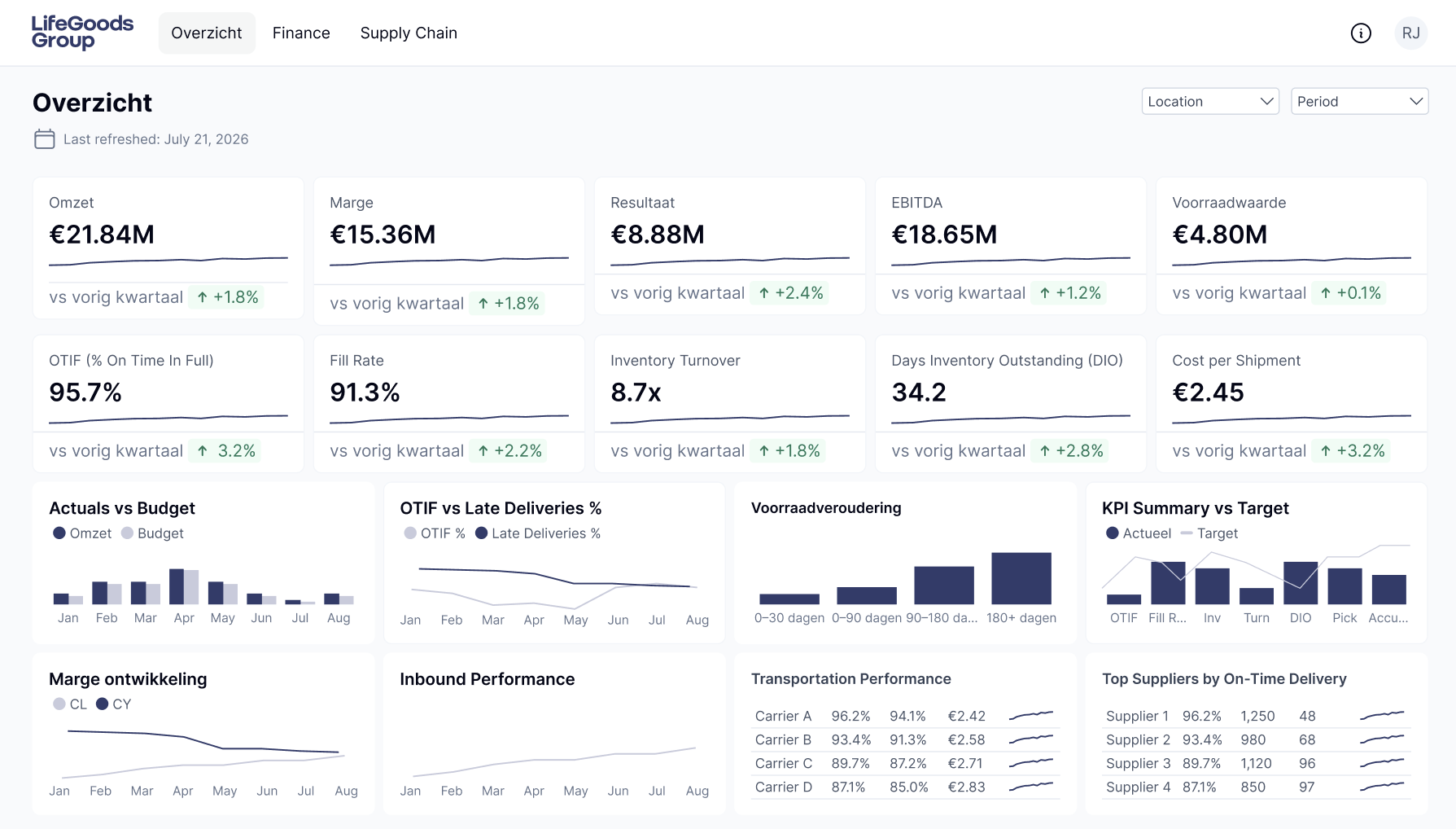
A dashboard shows what happened and where you stand today. That is insight, not AI. AI adds something to it: a prediction of what is likely to happen, or processing text from documents and e-mails. Both work best on the same underlying data.
How does Data Analytics help?
We work step by step, from question to working application. Data integration, data models, dashboards and AI applications belong together.

01
Define question and outcome
We sharpen the business question and agree what a usable outcome looks like.
02
Review data sources
We map which sources are available and how reliable they are.
03
Connect the data
Sources are connected into a data model with unambiguous definitions.
04
Build and test the application
We build a working version and test it for accuracy and usability.
05
Adopt and improve
The solution lands in daily work and keeps improving based on use.
Frequently asked questions
Wat is het verschil tussen AI en Machine Learning?
AI is de brede verzamelnaam voor systemen die taken uitvoeren waarvoor normaal menselijke intelligentie nodig is. Machine Learning is een onderdeel daarvan: het model leert patronen uit voorbeelden, in plaats van dat iemand elke beslisregel vooraf programmeert. Alle Machine Learning is AI, maar niet alle AI is Machine Learning.
Wat doet een data scientist?
Een data scientist vertaalt een zakelijke vraag naar een analyse of model. Dat betekent data verzamelen en opschonen, patronen onderzoeken, een model bouwen en toetsen, en de uitkomst zo presenteren dat er een beslissing op genomen kan worden.
Wat is generatieve AI?
Generatieve AI maakt zelf nieuwe inhoud: tekst, samenvattingen, code of afbeeldingen. In een zakelijke context gebruik je het vooral om documenten samen te vatten, concepten op te stellen of vragen in gewone taal te beantwoorden op basis van je eigen documenten en data.
Heb ik veel data nodig voor AI?
Niet altijd. Voor een voorspelmodel helpt historie, bijvoorbeeld een paar jaar aan verkoop- of ordergegevens. Voor tekstverwerking of zoeken in documenten is de kwaliteit en vindbaarheid van je data belangrijker dan de hoeveelheid. Betrouwbare data weegt zwaarder dan veel data.
Kan AI werken met gegevens uit mijn bestaande systemen?
Ja. Gegevens uit ERP, CRM, financiële pakketten, HR-systemen en Excel worden via koppelingen samengebracht in een datamodel. Dat model is de basis voor zowel dashboards als AI-toepassingen, zodat iedereen met dezelfde cijfers werkt.
Hoe begin ik met AI binnen mijn organisatie?
Begin bij één concrete vraag met een duidelijke ontvanger, bijvoorbeeld een betere voorraadvoorspelling of sneller documenten verwerken. Controleer welke data daarvoor beschikbaar is, bouw een kleine versie en toets of de uitkomst klopt en gebruikt wordt. Van daaruit breid je uit.
What can AI mean for your organisation?
Do you have a concrete question in mind? We are happy to think along about what is feasible with the data you already have.
Want to talk through your data question?
No sales pitch: a short 15-minute call with one of our specialists. Call us or leave your number.